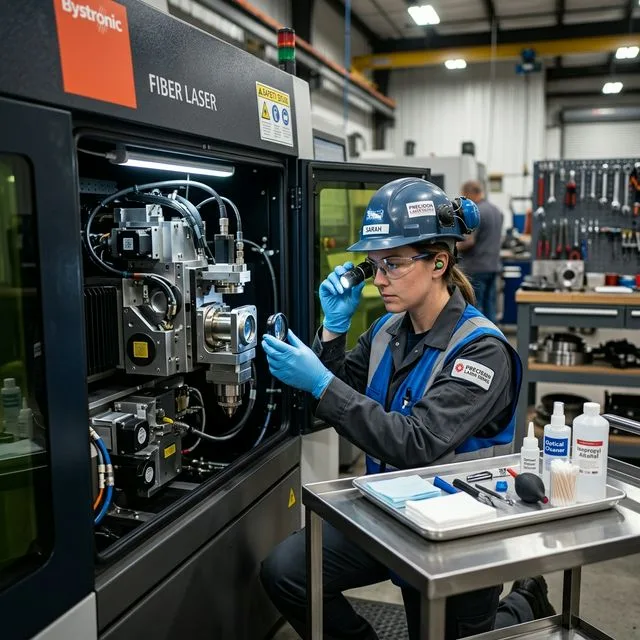
Comprehensive maintenance schedules and cost estimates for fiber and CO2 laser cutting systems. Use this professional guide to plan maintenance budgets, minimize downtime, and maximize equipment lifespan.
Fiber & CO2Schedules & CostsUpdated 2025-10-30
Maintenance Frequency Overview
Regular maintenance intervals ensure optimal performance and extend equipment lifespan
Fiber Laser Maintenance Schedule
Daily Maintenance
Check chiller temperature and flow rate— 2 minCritical
Remove slag and cutting waste from table— 10 minCritical
Inspect protective window for contamination— 3 minCritical
Verify assist gas pressure levels— 2 minCritical
Weekly Maintenance
Clean protective window with lens cleaner— 15 min ($5)Critical
Inspect cutting nozzle condition and alignment— 5 minCritical
Check beam path for contamination— 10 minCritical
Clean air filter and ventilation system— 15 min
Monthly Maintenance
Replace protective window— 10 min ($80-150)Critical
Clean focusing lens with proper solution— 20 min ($10)Critical
Clean and inspect chiller filters— 15 minCritical
Lubricate linear guides and ball screws— 25 min ($20)
Check and tighten mechanical fasteners— 20 min
Quarterly Maintenance
Replace chiller coolant (distilled water)— 45 min ($100-150)Critical
Inspect fiber cable and connectors— 20 minCritical
Calibrate cutting head parallelism— 60 minCritical
Replace cutting nozzles (full set)— 30 min ($200-400)
Annual Maintenance
Professional laser source inspection and service— 4-6 h ($2,500-5,000)Critical
Replace focusing lens assembly— 45 min ($400-900)Critical
Complete optical path inspection and cleaning— 2 h ($500-800)Critical
Precision calibration and beam quality test— 3 h ($800-1,500)Critical
Replace servo motor encoders (if needed)— 2 h ($600-1,200)
Annual Cost Estimate
Consumables
$2,000-3,500
Parts & materials
Service & Labor
$3,800-7,500
Professional service
Total Annual Cost
$5,800-11,000
Complete maintenance
Component Lifespan
Laser source module100,000 h (11-14 years)
Protective window1-3 months
Focusing lens12-24 months
Cutting nozzles1-6 months
Chiller system50,000 h (6-8 years)
CO2 Laser Maintenance Schedule
Daily Maintenance
Check chiller temperature and flow rate— 3 minCritical
Remove slag and cutting waste from table— 10 minCritical
Inspect protective window for contamination— 3 minCritical
Verify laser tube gas pressure (sealed tubes)— 2 minCritical
Weekly Maintenance
Clean all optical mirrors (M1, M2, M3)— 30 min ($15)Critical
Clean focusing lens with acetone/methanol— 20 min ($10)Critical
Inspect beam alignment through optical path— 15 minCritical
Clean extraction fan and exhaust system— 20 min
Monthly Maintenance
Replace protective window— 10 min ($40-100)Critical
Deep clean complete optical path— 60 min ($20)Critical
Inspect cooling system and water quality— 25 minCritical
Replace chiller coolant completely— 45 min ($80-120)Critical
Inspect laser tube condition and power output— 30 minCritical
Clean and service exhaust fan motor— 60 min ($50)
Replace air filter elements— 15 min ($30-60)
Annual Maintenance
Replace CO2 laser tube (sealed, as needed)— 3 h ($1,500-4,000)Critical
Replace focusing lens assembly— 30 min ($200-500)Critical
Replace complete mirror set (M1, M2, M3)— 90 min ($400-800)Critical
Professional optical alignment and calibration— 4 h ($800-1,500)Critical
RF power supply inspection and service— 2 h ($500-1,000)
Annual Cost Estimate
Consumables
$2,500-5,000
Parts & materials
Service & Labor
$2,000-4,000
Professional service
Total Annual Cost
$4,500-9,000
Complete maintenance
Component Lifespan
CO2 laser tube (sealed)10,000-20,000 h (2-4 years)
Protective window2-8 weeks
Focusing lens6-18 months
Optical mirrors12-24 months
Cutting nozzles2-8 weeks
RF power supply30,000-50,000 h (5-8 years)
Fiber vs CO2 Comparison
Item
Fiber
CO2
Daily maintenance time
17 min
18 min
Weekly maintenance time
45 min
85 min
Monthly maintenance time
90 min
150 min
Annual total maintenance cost
$5,800-11,000
$4,500-9,000
Laser source lifespan
100,000 h (11-14 years)
10,000-20,000 h (2-4 years)
Optical maintenance frequency
Low (monthly)
High (weekly)
Skill requirement
Low-Medium
Medium-High
Unplanned downtime risk
Very Low
Medium
Environmental sensitivity
Low
High
Consumables cost (annual)
$2,000-3,500
$2,500-5,000
Regular preventive maintenance by trained technicians reduces total maintenance costs by 30-50% compared to reactive approaches — a well-planned program prevents $10,000-40,000 emergency failures
Maintenance Quick Reference
Keep this maintenance schedule accessible to your operations team. Regular adherence to these schedules ensures optimal performance, prevents costly breakdowns, and extends equipment life.
Daily Tasks (15-20 min)
Temperature checks, waste removal, window inspection
Weekly Tasks (45-85 min)
Optical cleaning, nozzle inspection, system checks
Monthly Tasks (90-150 min)
Component replacement, deep cleaning, calibration
Annual Service (8-15 hours)
Professional inspection, major component replacement
Strategic Maintenance Planning
Preventive vs. Reactive Maintenance Economics
Industry data shows that facilities following structured preventive maintenance programs achieve 30-50% lower total maintenance costs compared to reactive approaches. A well-planned maintenance program prevents catastrophic failures that can cost $10,000-40,000 in emergency repairs and lost production for a 6kW fiber laser system. Regular protective window replacement ($80-150 monthly) prevents costly laser head contamination damage that can exceed $15,000 in repairs and downtime.
Critical Components and Replacement Cycles
Fiber Laser Systems: Laser source modules are typically rated for 100,000 operational hours (11-14 years at single-shift operation), with gradual power degradation beginning around 70,000-80,000 hours. Focusing lens assemblies require replacement every 12-24 months ($400-900). Protective windows need monthly replacement ($80-150). Chiller coolant replacement quarterly ($100-150) maintains optimal beam quality and prevents thermal issues.
CO2 Laser Systems: Sealed CO2 tubes typically last 10,000-20,000 hours (2-4 years at single-shift operation) with replacement costs of $1,500-4,000. Optical components (mirrors and lenses) require weekly cleaning and replacement every 6-24 months ($400-800 per complete set). Protective windows need replacement every 2-8 weeks ($40-100). RF power supplies typically last 30,000-50,000 hours with service costs of $500-1,000.
Automation and Predictive Maintenance
Modern laser systems increasingly incorporate IoT sensors and predictive analytics to optimize maintenance timing. Advanced monitoring systems track critical parameters including laser power output, cutting head temperature, lens contamination levels, and chiller performance. These systems alert operators before components fail, enabling scheduled maintenance during planned downtime. Predictive maintenance approaches can extend component life by 15-25% by identifying optimal maintenance windows and preventing premature replacements or catastrophic failures.
Production Scheduling and Maintenance Windows
High-volume fabrication shops running 2-3 shifts must carefully schedule maintenance to minimize production impact. Best practice is to reserve 4-6 hours weekly during lowest-demand periods for preventive tasks. Annual major maintenance (laser source inspection, full optics replacement, servo system calibration) should be scheduled during planned shutdowns (holidays, inventory periods) and typically requires 2-3 days for fiber lasers, 3-5 days for CO2 systems.
Spare Parts Inventory Strategy
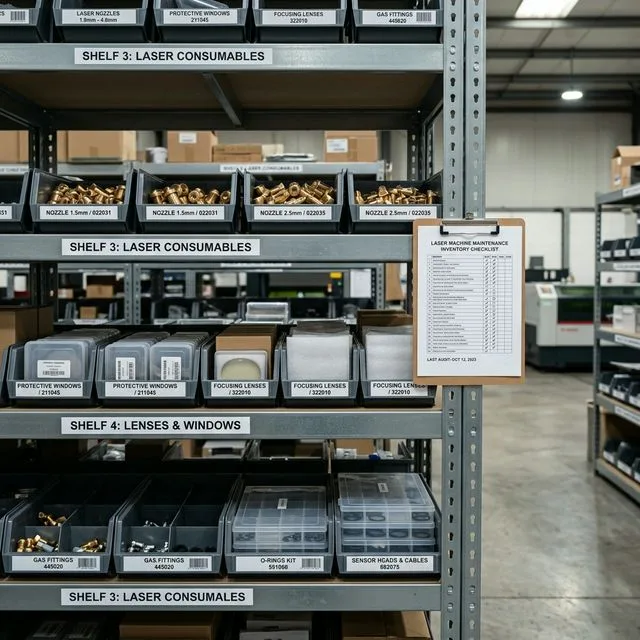
Critical spare parts inventory prevents extended downtime when components fail. Minimum recommended stock for single-machine operations includes protective windows (2-3 units), cutting nozzles (full set of common sizes 1.0-3.0mm), focusing lenses (1-2 units), and basic sensors. Multi-machine facilities should consider maintaining a complete cutting head assembly for immediate swap during failures. A reasonable spare parts investment ranges from 5-10% of machine purchase price for single machines, with economies of scale for larger fleets.
Critical spare parts inventory prevents extended downtime — minimum stock includes protective windows, cutting nozzles, focusing lenses, and basic sensors (5-10% of machine purchase price)
Environmental Factors and Maintenance Frequency
Operating environment significantly impacts maintenance requirements. Facilities with poor dust control, high humidity, or temperature fluctuations may require 20-40% more frequent maintenance. Shops cutting materials that generate significant particulates or fumes need more frequent protective window inspection and cleaning. Proper extraction systems and environmental controls reduce maintenance frequency and extend component life. Clean, climate-controlled facilities with effective fume extraction typically achieve the longest component lifespans and lowest maintenance costs.
Maintenance guidance compiled from manufacturer manuals and industry practice. Actual schedules depend on usage intensity, environment and model. Last updated: 2025-10-30.