Stainless Steel Laser Cutting Guide
Stainless steel is one of the most common materials for laser cutting, offering excellent corrosion resistance and aesthetic appeal. This guide covers 304/316 grades, nitrogen vs oxygen cutting, optimal parameters, and achieving mirror-finish edges.
Quick Reference
Use Nitrogen For:
- • Oxide-free, shiny edges
- • Food service, medical applications
- • Visible parts, decorative use
- • No post-processing needed
Use Oxygen For:
- • Lower cost (3-5× cheaper gas)
- • Parts will be painted/coated
- • Faster cutting speeds
- • Thick material (>10mm)
Stainless Steel Cutting Decision Path
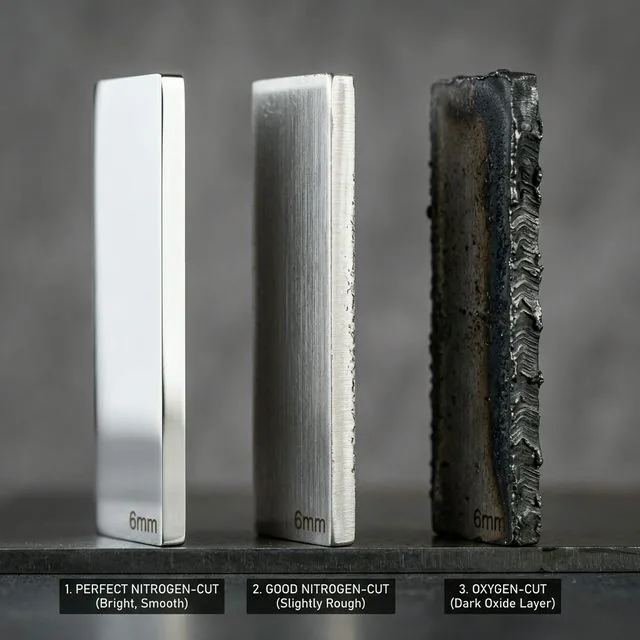
For 304 and 316 stainless, choose nitrogen when the edge must remain oxide-free for food, medical, architectural, or passivation-sensitive parts. Choose oxygen only when post-processing or coating will remove the oxide layer and gas cost matters more than edge appearance.
Common Stainless Steel Grades
| Grade | Composition | Characteristics | Applications |
|---|---|---|---|
| 304/304L | 18% Cr, 8% Ni | Most common, good corrosion resistance, non-magnetic | Food service, architecture, general fabrication |
| 316/316L | 16-18% Cr, 10-14% Ni, 2-3% Mo | Superior corrosion resistance, marine-grade | Chemical, marine, medical, pharmaceuticals |
| 430 | 16-18% Cr, low Ni | Ferritic, magnetic, lower cost | Automotive trim, appliances |
| 201/202 | High Mn, low Ni | Budget alternative to 304, less corrosion resistant | Indoor furniture, non-critical applications |
304 and 316 represent ~90% of stainless laser cutting applications. Cutting parameters are similar across grades.
Nitrogen Cutting Parameters (Oxide-Free)
| Thickness | Power | Speed | N₂ Pressure | Focus | Nozzle |
|---|---|---|---|---|---|
| 1mm | 2kW | 6-8 m/min | 12-14 bar | -1mm | 1.5mm |
| 2mm | 3kW | 4-5 m/min | 12-15 bar | -0.5mm | 2.0mm |
| 3mm | 4kW | 3-4 m/min | 13-16 bar | 0mm | 2.5mm |
| 5mm | 6kW | 2-2.8 m/min | 14-17 bar | +0.5mm | 3.0mm |
| 8mm | 10kW | 1.2-1.8 m/min | 15-18 bar | +1mm | 3.5mm |
| 10mm | 12kW | 0.9-1.4 m/min | 16-20 bar | +1.5mm | 4.0mm |
Nitrogen Advantages
- • Mirror-finish, oxide-free edges
- • No post-processing required
- • Ideal for visible/decorative parts
- • Food-safe, medical-grade finish
Nitrogen Disadvantages
- • High gas cost ($0.40-0.70/m³)
- • Requires 99.999% purity
- • High pressure = more consumption
- • Slower than oxygen cutting
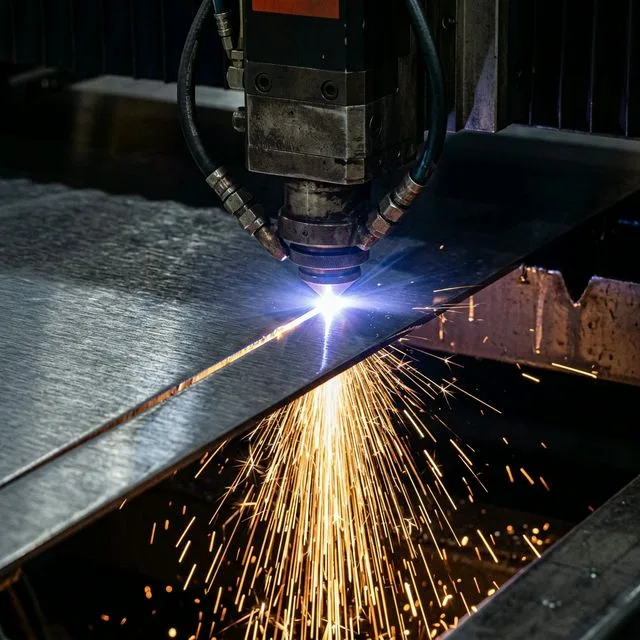
Oxygen Cutting Parameters (Faster, Lower Cost)
| Thickness | Power | Speed | O₂ Pressure | Focus |
|---|---|---|---|---|
| 3mm | 3kW | 3.5-4.5 m/min | 0.6-0.9 bar | 0mm |
| 5mm | 4kW | 2.2-3.0 m/min | 0.7-1.0 bar | +0.5mm |
| 8mm | 6kW | 1.3-1.8 m/min | 0.8-1.2 bar | +1mm |
| 10mm | 8kW | 1.0-1.5 m/min | 1.0-1.5 bar | +1.5mm |
Oxygen Cutting Note: Creates exothermic reaction (oxygen combustion) which adds heat energy. Results in 20-30% faster cutting but leaves black oxide edge. Use when parts will be painted, powder coated, or edge quality doesn't matter.
Nitrogen vs Oxygen: Detailed Comparison
| Factor | Nitrogen | Oxygen |
|---|---|---|
| Edge Appearance | Shiny, mirror-finish | Black oxide layer |
| Gas Cost (5mm, 1m cut) | $0.15-0.25 | $0.03-0.05 |
| Cutting Speed (5mm) | 2-2.8 m/min | 2.2-3.0 m/min |
| Post-Processing | None required | Deburr, grind if visible |
| Pressure | 12-20 bar (high) | 0.5-1.5 bar (low) |
| Dross Formation | Minimal | More common |
| Best For | Visible parts, food/medical | Painted parts, structural |
Best Practices for Quality Cuts
Material Preparation
- • Remove protective film before cutting
- • Clean surface oils with solvent
- • Check material flatness (max 2mm deviation)
- • Verify grade (304 vs 316 behave similarly)
- • Use clean support slats (no rust)
Nitrogen Purity
- • Use 99.999% (5.0) or 99.9999% (6.0) purity
- • Lower purity = oxidation on edge
- • Check supplier certification
- • Monitor tank pressure (delivery consistency)
- • Consider on-site generator for high volume
Nozzle Management
- • Match nozzle size to thickness (see table)
- • Replace nozzle every 50-80 hours
- • Check orifice for wear/damage daily
- • Maintain 0.5-1.5mm standoff distance
- • Clean exterior with brass brush
Focus Optimization
- • Thin (1-3mm): Negative focus (-1 to 0mm)
- • Medium (4-6mm): Near surface (0 to +1mm)
- • Thick (7mm+): Positive focus (+1 to +3mm)
- • Test focus in 0.5mm increments
- • Record optimal settings by thickness
Troubleshooting Common Issues
Problem: Dross/Burr on Bottom Edge
Causes: Too slow speed, low gas pressure, worn nozzle
Solutions:
- Increase cutting speed 10-15%
- Increase nitrogen pressure 2-3 bar
- Check and replace worn nozzle
- Verify proper nozzle-to-material distance
Problem: Oxidation on Nitrogen Cut Edge
Causes: Impure nitrogen, air leak, insufficient pressure
Solutions:
- Verify nitrogen purity (>99.99%)
- Check all gas line connections for leaks
- Increase pressure slightly
- Inspect cutting head seals
Problem: Rough/Wavy Edge
Causes: Incorrect focus, unstable process, worn lens
Solutions:
- Fine-tune focus position (±0.5mm test)
- Optimize speed-power balance
- Check lens cleanliness/damage
- Verify beam alignment
Data Sources
- • Trumpf Stainless Steel Process Guide 2024: Cutting parameters and best practices
- • ISO 9013:2017: Thermal cutting quality classification
- • Bystronic Stainless Cutting Handbook: Nitrogen vs oxygen comparison
- • ASM Stainless Steel Handbook: Grade characteristics and metallurgy
- • Field data: 10,000+ hours production experience
Disclaimer: Parameters are starting points for typical 304/316 stainless steel. Optimal settings vary with specific grade, surface finish, machine capabilities, and quality requirements. Always test on scrap material first.