5-Axis & 3D Laser Cutting Machines
When parts aren't flat, you need 5-axis capability. From hot-stamped auto body panels to aerospace composites, 3D laser cutting opens possibilities that 2D machines can't touch.
Platform Options
- Gantry 5-Axis: Highest precision, limited work envelope
- Robot (6-Axis): Large reach, lower precision, flexible
- Hybrid: Robot on linear track for best of both
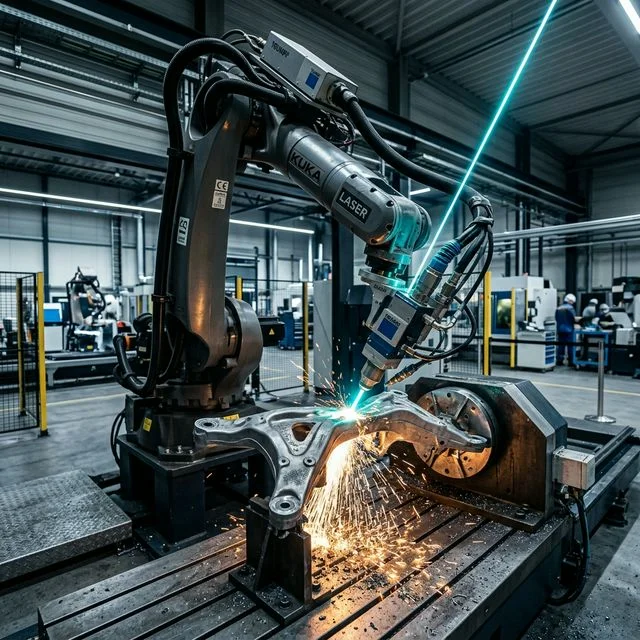
5-Axis Laser Cell Fit Path
Decide between gantry, robot, and hybrid 5-axis laser cutting by part envelope, tolerance target, fixture repeatability, offline programming effort, and safety enclosure. A 5-axis fiber laser is a cell-integration purchase, not only a cutting-head purchase.
Typical Applications
Automotive
The largest application by volume. Hot-stamped ultra-high-strength steel (UHSS) parts—B-pillars, door rings, bumper beams—require laser trimming after forming. Traditional die trimming is impractical at these hardness levels.
- Hot-formed structural parts (1500+ MPa steel)
- Hydroformed tubes
- Aluminum body panels
- Prototype parts and low-volume production
Aerospace
- Engine component trimming (Inconel, Ti)
- Composite structure trimming
- Formed sheet metal parts
Other Industries
- Medical implants and devices
- Agricultural equipment
- Heavy machinery components
- Architectural formed metal
Gantry 5-Axis Systems
Purpose-built 5-axis machines with a cutting head that can tilt ±90° or more. The beam is typically delivered through a hollow wrist for consistent beam quality at all angles.
Advantages
- Highest positioning accuracy (±0.03mm achievable on premium machines)
- Fastest dynamics on small features
- Consistent beam delivery at all angles
- Enclosed for safety and environment control
Limitations
- Fixed work envelope (typically 2-4m range)
- Higher capital cost than robots
- Less flexible for varied part sizes
Key Players
- TRUMPF: TruLaser Cell series (e.g., 8030, 7040)
- Prima Power: Laser Next series (e.g., 2141, Core)
- BLM: LT-FREE (hybrid 3D part and tube cell)
Explore specialized 3D cutting systems in our equipment database.Browse equipment →
Robot-Based 3D Cutting
Industrial robots (typically 6-axis) with fiber laser cutting heads. Common robot brands include FANUC, KUKA, ABB, and Yaskawa. Specialized integrated robotic systems, such as the Jenoptik VOTAN BIM, feature internal beam guidance within the robot arm for maximum accessibility.
Advantages
- Large work envelope (2-3m reach)
- Flexible—same robot can weld, cut, handle parts
- Lower capital cost than gantry systems
- Easy to reposition for different applications
Limitations
- Lower accuracy than gantry (±0.1-0.2mm typical)
- Path accuracy degrades at full reach
- More complex offline programming
- Beam delivery challenges for high power
Fixturing: The Hidden Challenge
3D cutting is only as good as your part holding. Unlike flat sheet work, formed parts need custom fixtures:
- Match the part geometry precisely
- Provide consistent clamping forces
- Allow beam access from all angles
- Accommodate part-to-part variation
Budget 20-30% of system cost for initial fixturing. High-volume automotive production cells (like those for hot-stamped B-pillars) often utilize rotary tables or dual-station handling systems to allow loading/unloading during the cutting cycle, maximizing OEE (Overall Equipment Effectiveness).
Programming Considerations
5-axis programming is fundamentally different from 2D nesting:
- CAD-to-CAM: Import 3D models, define cut paths
- Collision detection: Simulate tool/part/fixture interaction
- Compensation: Account for spring-back and thermal distortion
- Path optimization: Minimize idle moves, manage acceleration
Investment Levels
| Configuration | Typical Investment |
|---|---|
| Robot cell (basic) | $250-400K |
| Robot cell (production) | $400-700K |
| Gantry 5-axis (compact) | $500-800K |
| Gantry 5-axis (production/high-power) | $800K - $2.0M+ |
Explore 3D Cutting
Browse our database for 3D and robotic laser cutting systems.