Automated Laser Cutting Systems for Lights-Out Manufacturing
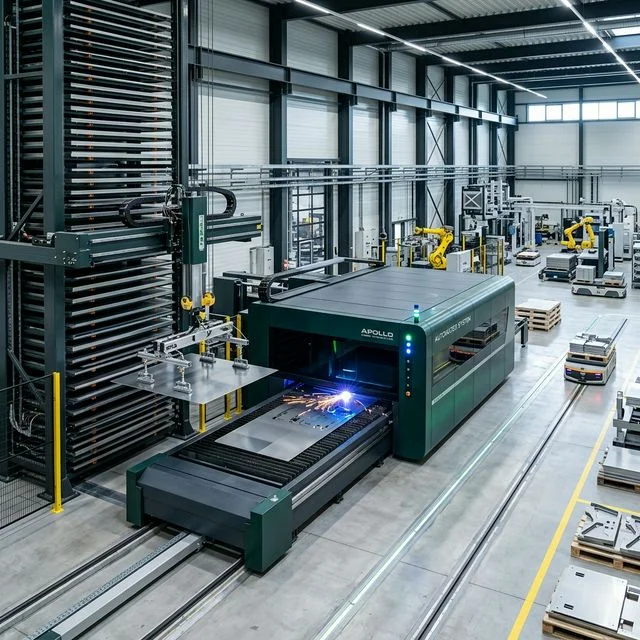
Labor shortages are pushing shops toward automation. A fully automated laser cell can run unmanned for 8, 16, or even 24 hours. Here's how to evaluate automation options.
Automation Levels
- Level 1: Pallet changer (5-10 min sheet changes)
- Level 2: Tower storage (8+ hour unmanned operation)
- Level 3: Full FMS with sorting (24/7 capability)
The Business Case for Automation
A standalone laser with manual loading has 40-60% spindle utilization at best—operators go home, take breaks, set up jobs. Automation can push utilization above 80-90%, effectively doubling output from the same footprint.
| Configuration | Typical Utilization | Annual Output (hours) |
|---|---|---|
| Manual, 1 shift | 35-45% | ~1,800 |
| Manual, 2 shifts | 50-60% | ~3,500 |
| Automated, 2 shifts | 70-85% | ~5,500 |
| Lights-out, 24/7 | 80-95% | ~7,500+ |
Automation Components
1. Sheet Storage Systems
The foundation of unmanned operation. Tower systems store 10-50+ pallets of raw material and finished sheets.
- TRUMPF TruStore: Modular towers, integrates with TruLaser
- Amada ASF/AMS: Automated storage factories and flexible towers
- Prima Power Night Train FMS: Scalable factory-wide storage system
- Bystronic ByTower: Compact, integrated material storage
2. Loading/Unloading
Gets sheets on and off the table while the laser keeps cutting.
- Automated Load/Unload (e.g., Bystronic ByTrans, Amada AS): Handles raw sheets and removes cut skeletons efficiently
- Vacuum loading: Picks individual sheets, handles warped material
- Magnetic grippers: Ferrous materials only, very fast
3. Part Sorting
The final frontier. Automated sorting eliminates the shake-and-break process of manual part removal.
- TRUMPF SortMaster: AI vision + suction cups
- Amada TK: Integrated sorting with ASR 3015
- Bystronic BySort: Robotic arm with vision
Laser Platforms for Automation
These machines integrate with manufacturer automation ecosystems.
Software Integration
Automation is only as good as the software controlling it:
- Job scheduling: Queue jobs across shifts
- Material management: Track inventory, optimize cuts
- MES integration: Connect to ERP for order-driven production
- Remote monitoring: Mobile alerts, camera feeds
Prerequisites for Success
- Consistent material: Automation hates surprises—standardize thicknesses
- Reliable nesting: Parts must release cleanly from skeleton
- Job diversity: Enough different jobs to fill unmanned hours
- Facility infrastructure: Power, cooling, floor space for towers
- Staff mindset: Shift from operators to technicians
Investment Levels
| Level | Additional Investment | Payback Period |
|---|---|---|
| Basic Load/Unload | $100-150K | 6-12 months |
| Tower System | $200-500K | 1-2 years |
| Full FMS + Sort | $800K-2M+ | 2-4 years |
Calculate Your ROI
Use our cost calculator to model automation payback.