Best Laser Cleaning Machines for Industrial Use
Laser cleaning is replacing sandblasting, chemical stripping, and wire brushing across industries. It's faster, cleaner, and increasingly cost-competitive. Here's how to choose the right system.
Key Takeaways
- Pulsed lasers (50W-2000W): Non-destructive cleaning, high precision, no heat damage to substrate
- CW lasers (1000W-3000W+): Brutal rust removal, but introduces high heat (melting risk)
- Backpack/Portable: 100W-200W battery-powered units dominate 2026 mobile maintenance
Laser Cleaning Machine Buyer Path
Choose pulsed or CW cleaning by substrate risk, coating thickness, cleaning rate, fume extraction, safety controls, and portable versus automated workflow. For 1kW laser cleaning machine searches, separate 1000W pulsed precision systems from 1000W-1500W CW cleaners used on heavy steel where heat input is acceptable.
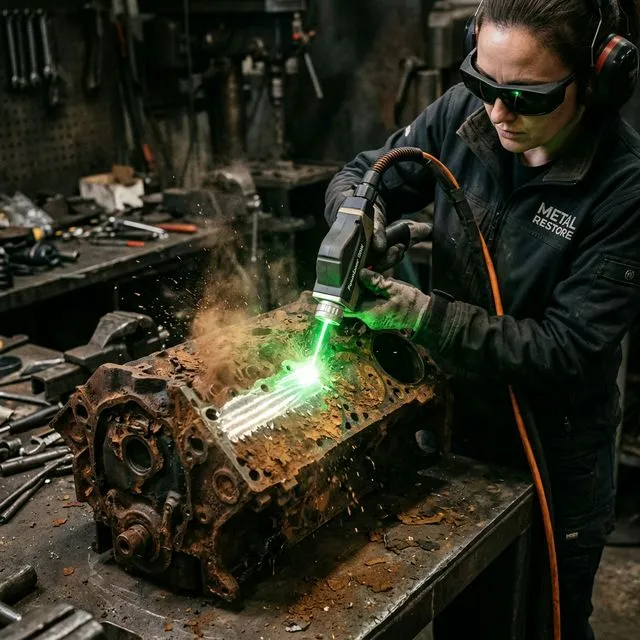
Why Laser Cleaning?
Compared to traditional methods, laser cleaning offers:
- No consumables: No media, no chemicals, no disposal costs
- Precision: Remove coating without damaging substrate
- Safety: No silica dust, no toxic chemicals
- Speed: 2-10× faster than manual methods on complex geometries
- Consistency: Reproducible results, programmable parameters
Applications by Industry
Manufacturing
- Mold cleaning (rubber, tire, injection)
- Weld preparation and post-weld cleanup
- Paint stripping for rework
- Surface activation before bonding
Aerospace & Defense
- Coating removal from turbine blades
- Anodize removal for repair
- Composite surface preparation
Heritage/Restoration
- Stone and metal artifact cleaning
- Historic building facades
- Art restoration
Marine & Infrastructure
- Ship hull rust removal
- Bridge and structural steel maintenance
- Pipeline reconditioning
Laser Cleaning Systems
Pulsed vs Continuous Wave (CW)
Pulsed Lasers (MOPA / Q-Switched)
High peak power in short bursts (nanosecond range). The rapid heating/cooling cycle ablates contaminants while the substrate stays completely cool. In 2026, pulsed systems scale up to 2000W. Best for:
- Thin coatings (paint, oxide layers)
- Heat-sensitive substrates
- Precision work (mold textures, delicate parts)
Continuous Wave (CW)
Often sold as cheap "3-in-1" welder/cleaner/cutters. Operates at 1000W-3000W+ for aggressive material removal. Generates massive heat, which will micro-melt or warp thin substrates. Best for:
- Heavy rust and scale
- Thick paint (multiple layers)
- High-speed production cleaning
Power Selection Guide
| Power | Cleaning Rate | Typical Applications |
|---|---|---|
| 50-100W | 1-3 m²/hr | Precision cleaning, delicate substrates |
| 200-300W | 5-10 m²/hr | General industrial, mold cleaning |
| 500W-2000W Pulsed | 15-30+ m²/hr | High-speed non-destructive cleaning (aerospace, NDT prep) |
| 1000W+ CW | 30-50+ m²/hr | Thick rust on heavy structural steel (where heat warping isn't an issue) |
Handheld vs Automated
Handheld Systems & Backpacks
Portable units with pistol-grip applicators. The biggest trend in 2026 is the100W-200W Pulsed Backpack Laser. Weighing under 15kg with optional lithium battery power, these allow operators to clean scaffolding, bridges, and hard-to-reach areas without dragging a massive chiller cart.
Automated/Robotic
Fixed or robot-mounted scan heads for consistent, high-volume cleaning. Common in mold cleaning stations and production lines. Higher capital cost but lower per-part cost at volume.
Top Manufacturers in 2026
- IPG Photonics: LightCLEAN series (leveraging their cleanLASER acquisition) for premium, high-power pulsed cleaning.
- Laser Photonics: CleanTech systems, dominant in military and heavy industrial sectors.
- Asian Innovators: Brands like JPT, SFX, and Bodor offering highly cost-effective and ultra-portable MOPA pulsed systems.
Safety Considerations
- Eye protection (OD 5+ for 1064nm)
- Fume extraction (ablated material is vaporized)
- Fire watch (some coatings are flammable)
- Training on laser safety standards (ANSI Z136, IEC 60825)
Explore Surface Treatment
Compare laser cleaning with other surface preparation methods.
Browse All Equipment →