Best Laser Marking & Engraving Machines for Industrial Use
From UDI compliance on medical devices to branding jewelry, laser marking is everywhere in manufacturing. Here's how to choose the right technology and machine for your application.
Quick Technology Guide
- Fiber (1064nm): Metals, plastics with additives, most versatile
- CO2 (10.6µm): Organics—wood, paper, leather, acrylic, glass
- UV (355nm): Sensitive plastics, medical, cold marking
- Green (532nm): Copper, gold, reflective metals
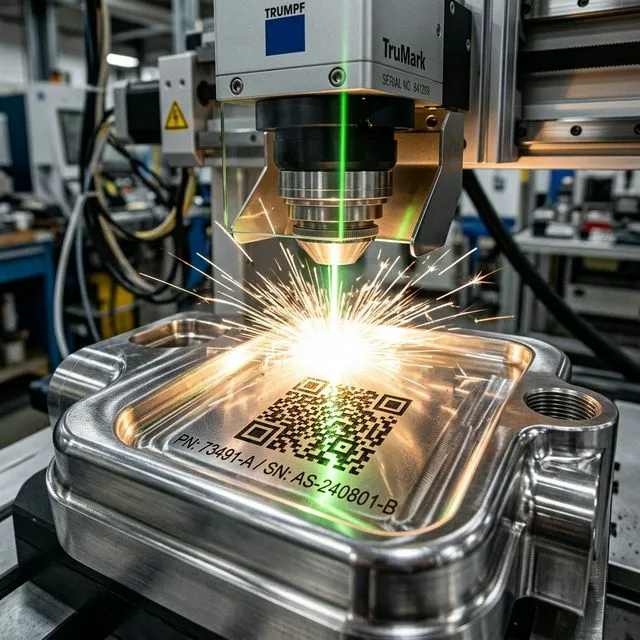
Marking vs Engraving: What's the Difference?
Technically, "marking" refers to surface-level discoloration or oxidation, while "engraving" removes material. In practice, most industrial lasers do both depending on power settings.
- Marking: QR codes, logos, serial numbers—readable but minimal depth
- Engraving: Deep cuts for wear resistance, tactile feel, or aesthetic depth
Fiber Laser Markers: The Workhorse
In 2026, 30W to 100W+ fiber lasers handle 90% of industrial marking needs. They excel on:
- Steel, stainless, aluminum (annealing, etching, deep engraving)
- Engineering plastics with laser additives (ABS, PA, PBT)
- Coated surfaces (removing paint/anodizing to expose base material)
Don't use fiber on: Clear plastics, wood, paper, leather, or glass.
Fiber Laser Markers
CO2 Laser Markers
CO2 Markers: Organic Materials
The 10.6µm wavelength of CO2 lasers is readily absorbed by organic materials. Use CO2 for:
- Wood products (MDF, plywood, solid wood)
- Paper and cardboard packaging
- Leather goods
- Acrylic and many plastics (flame-polished edges)
- Glass (fracture marking)
UV and Green: Specialty Applications
UV lasers (355nm, typically 5W-15W) produce "cold marking" with minimal heat input. Essential for:
- Medical devices requiring biocompatible marks
- Clear and sensitive plastics (PVC, silicone, HDPE)
- Electronics where heat could damage components
Green lasers (532nm) are the choice for reflective metals like copper and gold, where fiber lasers struggle with absorption.
Key Specifications
Power
More power = faster marking or deeper engraving. 30W handles basic traceability marking. 50W to 100W+ (such as the JPT M8 series) is required for deep engraving (firearms, molds) or high-speed production lines.
Field Size (Work Area)
Determined by the galvo lens. Common sizes: 110×110mm, 175×175mm, 300×300mm. Larger fields mean larger spot size and lower detail resolution.
Pulse Duration (MOPA vs Q-Switched)
MOPA (Master Oscillator Power Amplifier) fiber lasers offer adjustable pulse duration (often 2-500ns) for precise material responses. It is the definitive choice in 2026 for high-contrast black marking on anodized aluminum, color marking on stainless steel, and delicate plastic etching.
Top Manufacturers in 2026
- Keyence & Telesis: High-end industrial integration, 3-axis autofocus control (e.g., Keyence MD-U UV series).
- TRUMPF (TruMark): Premium European quality for rigorous automotive/medical environments.
- JPT, IPG & Raycus (Source Makers): Engine builders powering a massive global market of affordable, highly capable desktop markers (integrated by brands like SFX, OMTech, Cloudray).
Integration Considerations
- Standalone workstation: Class 1 enclosure, manual part loading
- Desktop unit: Compact, often unenclosed (Class 4 laser safety)
- Integration-ready: Bare scan head for robotic or conveyor mounting
Browse Marking Equipment
Explore our full catalog of laser marking and engraving systems.
View All Marking Lasers →