Best Metal 3D Printers for Industrial Production
Metal additive manufacturing has moved beyond prototyping into production. Aerospace, medical, and tooling industries are running metal AM 24/7. Here's what you need to know to enter this space.
Technology Overview
- L-PBF (Powder Bed Fusion): Highest precision, complex geometries, small to medium parts
- DED (Directed Energy Deposition): Larger parts, repair applications, hybrid machining
- Binder Jetting: Highest throughput, lower cost per part, post-sintering required
Metal 3D Printer Shortlist Path
Shortlist metal 3D printers by build volume, laser count, alloy qualification, powder workflow, post-processing load, and service/material validation. For M2 Series 5 style purchase intent, compare the quoted system against similarly sized L-PBF machines instead of treating laser count or chamber size as the final buying answer.
Is Metal AM Right for Your Application?
Metal 3D printing makes sense when at least one of these is true:
- Geometry: Internal channels, lattice structures, topology-optimized shapes impossible to machine
- Volume: Low volume (1-1000 parts) where tooling cost can't be amortized
- Lead time: Need functional metal parts in days, not weeks
- Material waste: Expensive materials (titanium, Inconel) where buy-to-fly ratio matters
If you're making 10,000+ simple parts from mild steel, traditional manufacturing likely wins.
Laser Powder Bed Fusion (L-PBF)
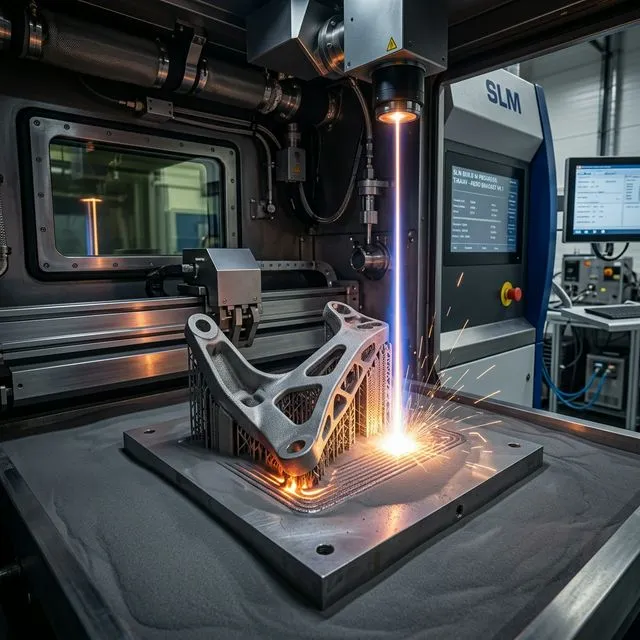
Also called SLM (Selective Laser Melting) or DMLS (Direct Metal Laser Sintering). This is the dominant technology for precision metal AM.
How It Works
A laser selectively melts thin layers (20-100µm) of metal powder. The build platform lowers, a recoater spreads fresh powder, and the process repeats. Build times are long—complex parts can take 20-100+ hours.
Key Players in 2026
- Nikon SLM Solutions: Pioneering massive 12+ laser systems (NXG XII 600)
- EOS & TRUMPF: The German stalwarts with the most mature materials and support
- Colibrium Additive (formerly GE Additive): Deeply integrated in aerospace (M Line, Spectra)
- Velo3D: The gold standard for support-free, complex internal channel geometries
- Chinese Innovators (BLT, Eplus3D, Farsoon): Disrupting the market with massive 16 to 32+ laser large-format machines at aggressive pricing
Metal AM Systems in Our Database
Build Volume vs Speed Trade-offs
Larger build chambers allow bigger parts but don't proportionally increase throughput. Multi-laser systems (now scaling from 12 up to 32+ lasers in 2026) dramatically improve productivity for serial production but add complex gas flow and soot management challenges.
| Class | Build Volume | Typical Price | Best For |
|---|---|---|---|
| Compact | ~100×100×100mm | $100-300K | Dental, jewelry, small medical |
| Mid-size | ~250×250×300mm | $300-600K | Aerospace components, tooling |
| Large | 400×400×400mm+ | $700K-1.5M+ | Large aerospace, automotive |
Material Considerations
Metal AM systems are often certified for specific powder materials:
- Stainless (316L, 17-4PH): General purpose, well-understood
- Titanium (Ti6Al4V): Aerospace, medical implants, requires inert atmosphere
- Inconel (718, 625): High-temp aerospace, energy
- Aluminum (AlSi10Mg): Lightweight structures, challenging to process
- Tool Steel (H13, Maraging): Conformal cooling inserts
Beyond the Machine: Total Cost of Ownership
The printer is often less than half the total investment:
- Powder handling: Sieving, storage, recycling systems
- Post-processing: Heat treatment furnaces, wire EDM for support removal, machining
- Quality: CT scanning, metallurgical analysis
- Facility: Inert gas supply, fire suppression, powder-safe HVAC
- Training: Design for AM, parameter development, powder metallurgy
Getting Started: Recommendations by Industry
Aerospace
Go with established players (EOS, Nikon SLM Solutions, Colibrium Additive) with mature qualification pathways. AS9100 compatibility and material traceability are critical.
Medical/Dental
EOS, TRUMPF, and 3D Systems dominate with FDA/CE-cleared materials and workflows for titanium implants. For high-volume, lower-cost parts like dental crowns or surgical instruments, Binder Jetting (Desktop Metal, HP) is highly viable.
Tooling & Mold Making
Conformal cooling channels are the killer app. DED (Directed Energy Deposition) is highly relevant here—companies like Meltio offer wire-laser DED heads integrated directly into 5-axis CNC machines for seamless hybrid manufacturing and repair.
Explore Additive Manufacturing
Browse our database of metal 3D printing and additive manufacturing systems.
View All Metal AM Systems →