BPP (Beam Parameter Product): The Complete Technical Guide
Key Takeaway
BPP = w₀ × θ (beam waist radius × half-divergence angle, in mm·mrad). It determines focused spot size and is wavelength-independent, unlike M². Ideal Gaussian: BPP = λ/π = 0.34 mm·mrad at 1.06μm. Lower BPP → smaller focus → higher power density → faster, thinner cutting.
BPP to Process Impact Path
Read BPP as a source-to-workpiece constraint: calculate spot size from BPP and optics, verify M² consistency, then decide whether focus position, lens choice, or power density is the real limit before changing cutting parameters.
BPP is the fundamental metric that connects laser source properties to cutting performance. While M² is the most commonly cited beam quality factor, BPP provides additional insight by retaining wavelength information and directly predicting spot size. This guide covers the physics, practical applications, and manufacturer data for all major laser types.
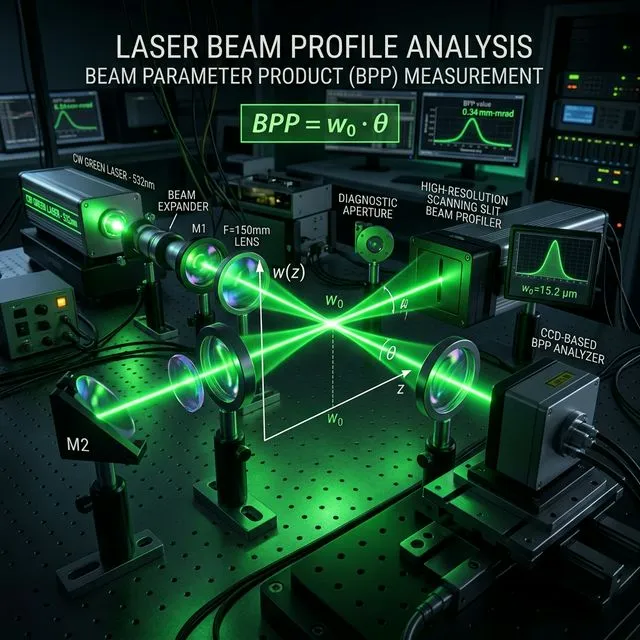
1. BPP Physics and Calculation
BPP is conserved through ideal optical systems — a lens cannot improve BPP, only trade waist size for divergence and vice versa. This is the optical analog of the Heisenberg uncertainty principle.
2. BPP Values by Laser Type
| Laser Type | Wavelength | Typical BPP | Equivalent M² | Typical Application |
|---|---|---|---|---|
| Single-mode fiber | 1.06-1.08μm | 0.35-0.40 | 1.03-1.18 | Precision thin sheet cutting |
| Multi-mode fiber (3-6kW) | 1.06-1.08μm | 0.5-2.0 | 1.5-5.9 | General metal cutting |
| High-power fiber (12-30kW) | 1.06-1.08μm | 2.0-8.0 | 5.9-23.6 | Thick plate, welding |
| Disk laser (Trumpf TruDisk) | 1.03μm | 2.0-8.0 | 6.1-24.4 | Cutting & welding |
| CO₂ (RF-excited) | 10.6μm | 3.5-7.0 | 1.04-2.07 | Metal & non-metal cutting |
| Direct diode | 0.9-1.0μm | 15-60 | 47-200 | Welding, cladding, heat treating |
3. BPP Impact on Cutting Performance
Focused Spot Size
Example: BPP = 0.4 mm·mrad, f = 150mm, D = 25mm → d_focus ≈ 0.096mm = 96μm. With BPP = 4 mm·mrad → d_focus ≈ 0.96mm = 960μm.
10× BPP = 10× spot diameter = 100× spot area = 100× lower power density.
Processing Implications
4. BPP and Fiber Delivery
When a laser beam is coupled into a delivery fiber, the fiber core diameter and numerical aperture (NA) set a minimum BPP. The delivered BPP is always equal to or worse than the source BPP:
| Fiber Core (μm) | NA | Fiber BPP (mm·mrad) | Typical Use |
|---|---|---|---|
| 14 | 0.08 | 0.56 | Single-mode precision cutting |
| 50 | 0.08 | 2.0 | Multi-mode general cutting |
| 100 | 0.12 | 6.0 | High-power cutting |
| 200 | 0.15 | 15.0 | Welding, cladding |
Frequently Asked Questions
What is BPP?
BPP (Beam Parameter Product) = beam waist radius × half-divergence angle, in mm·mrad. It is a wavelength-independent measure of beam quality that directly determines the minimum achievable focused spot size. Lower BPP = smaller focus = higher power density.
What is the difference between BPP and M²?
M² is dimensionless and normalizes BPP by wavelength (M² = BPP × π / λ). Use BPP to compare beams at different wavelengths (e.g., fiber at 1.06μm vs CO₂ at 10.6μm). Use M² to compare beams at the same wavelength. See our M² Measurement Tutorial for practical measurement procedures.
What BPP do I need for laser cutting?
Thin sheet precision (<3mm): BPP < 1 mm·mrad. General cutting (3-12mm): BPP = 1-4 mm·mrad. Thick plate (> 12mm): BPP = 2-8 mm·mrad. Higher BPP is acceptable for thicker materials where absolute spot size is less critical than total power delivered.
Related Guides
BPP values sourced from published specifications of major laser manufacturers (IPG, Trumpf, nLIGHT, Coherent, Raycus) and peer-reviewed literature. Fiber delivery BPP calculations assume equilibrium mode distribution. Actual delivered BPP may vary with fiber bending, length, and launching conditions.