M² Measurement Tutorial: How to Measure Laser Beam Quality Factor
Key Takeaway
M² is measured via ISO 11146 caustic scan: focus the beam, measure beam width at 10+ positions through focus, fit to Gaussian propagation model. An automated system does this in 5-15 minutes. Target M² < 1.1 for single-mode fiber, 1.5-5.0 for multi-mode cutting lasers.
M² Measurement Validation Path
Use the tutorial as a repeatable lab workflow: confirm attenuation is camera-safe, capture at least 10 beam-width points around the waist, reject saturated frames, then compare the fitted M² against expected cutting performance before updating a parameter library.
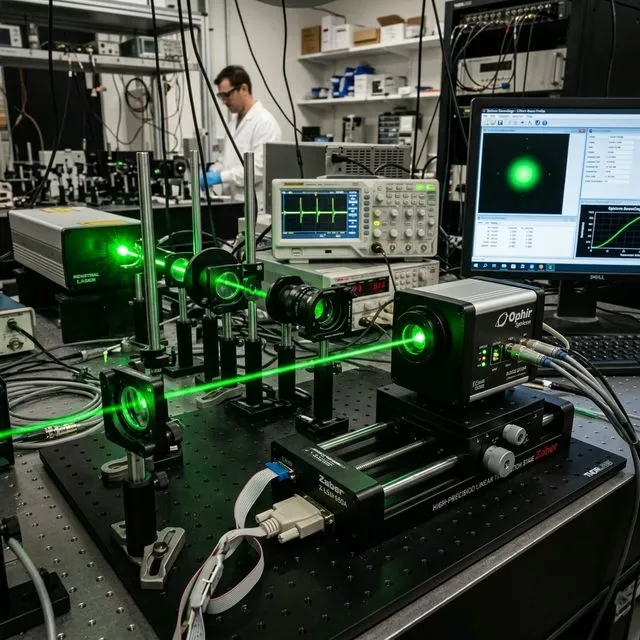
M² (beam quality factor) determines your focused spot size and thus your cutting capability. This tutorial walks through the complete measurement procedure from equipment setup to data analysis. For a broader overview of beam quality metrics including BPP and divergence, see our Beam Quality Guide.
1. What M² Tells You
M² is the ratio of your beam's divergence-waist product to that of an ideal Gaussian beam. M² = 1.0 is the theoretical limit (perfect TEM₀₀ mode). Real beams always have M² ≥ 1.0.
A beam with M² = 2 produces a focused spot with 2× the area of a M² = 1 beam using the same optics. This means 50% lower power density at the workpiece. For cutting:
2. Required Equipment
| Component | Purpose | Recommended | Budget |
|---|---|---|---|
| Beam profiler | Measure beam width at each z-position | Ophir-Spiricon SP928, Thorlabs BC106N | $3,000-8,000 |
| Focusing lens | Create artificial beam waist for measurement | f = 100-300mm, AR coated for laser wavelength | $100-500 |
| Translation stage | Move profiler along beam axis | 100mm+ travel, motorized preferred | $500-3,000 |
| Attenuator | Reduce beam power to camera-safe levels | ND filters or wedge beam sampler | $200-1,000 |
| M² analysis software | Fit beam width data to propagation model | Ophir BeamGage, Thorlabs BeamAlyzer | Included with profiler |
3. ISO 11146 Measurement Procedure
4. Common Measurement Pitfalls
Without adequate far-field data, the fit cannot accurately determine beam divergence. ISO 11146 explicitly requires ≥ 5 points beyond 2× Rayleigh range. Missing these gives artificially low M².
ISO 11146 mandates D4σ (second moment) beam width. The 1/e² clip-level method underestimates the width of non-Gaussian beams and gives artificially good M² values.
A saturated camera clips the peak of the beam profile. This artificially widens the measured beam width and inflates M². Always check the peak pixel value is below 80% of camera dynamic range.
Stray light or camera noise adds to the second-moment width calculation, inflating M². Apply proper background subtraction. ISO 11146 recommends the iterative baseline subtraction method.
Frequently Asked Questions
How do you measure M² of a laser beam?
Focus the beam through a lens, measure the beam width (D4σ method) at 10+ positions through the focus, fit to the Gaussian propagation model, extract M². ISO 11146 defines the full procedure. Automated systems complete this in 5-15 minutes.
What M² is good for laser cutting?
Single-mode fiber: M² < 1.1 (excellent). Multi-mode cutting lasers (3-12kW): M² = 1.5-3.0 (standard). High-power (12-30kW): M² = 3-5 (acceptable for thick plate). See the BPP guide for how M² relates to focused spot size and processing parameters.
What equipment do I need?
Minimum: beam profiler ($3-8K), focusing lens ($100-500), translation stage ($500-3K), attenuator ($200-1K). Or purchase an integrated M² system ($15-40K) for automated measurements. The profiler software typically includes M² fitting algorithms.
Related Guides
Measurement procedure follows ISO 11146-1:2021 (laser beam widths, divergence angles, and beam propagation ratios). Equipment pricing reflects 2025-2026 North American/European market. Always follow laser safety protocols (IEC 60825) when performing beam measurements.