Edge Roughness Measurement: Rz5, Ra & Profile Methods for Laser Cutting
Key Takeaway
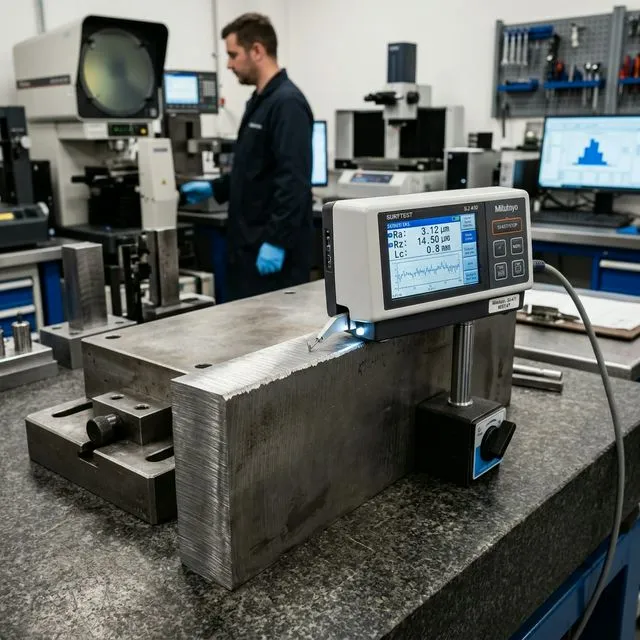
Rz5 is the standard metric for laser cut edge quality per ISO 9013. Measure it with a portable profilometer at mid-height on the cut edge. Target Rz5 < 30μm for precision work (ISO 9013 Range 1-2). Visual reference charts enable rapid production QC without instruments.
Edge roughness is the most visible indicator of cut quality. This guide covers the measurement methods, equipment, and interpretation techniques used in production facilities. For the full quality classification system, see our ISO 9013 Practical Guide.
1. Key Roughness Metrics
| Metric | Definition | ISO Standard | Use Case |
|---|---|---|---|
| Rz5 | Mean peak-to-valley height over 5 sampling lengths | ISO 9013 | Primary laser cut metric |
| Ra | Arithmetic mean deviation from mean line | ISO 4287 | General engineering drawings |
| Rz | Maximum peak-to-valley in single sampling length | ISO 4287 | Identifying isolated defects |
| Rt | Total height of profile (max peak to max valley) | ISO 4287 | Worst-case assessment |
2. Measurement Methods
Contact Profilometer
A diamond stylus (2μm tip radius) traces across the surface. The vertical displacement is recorded as the surface profile.
Optical / Non-Contact
Laser confocal or white-light interferometry scans the surface without touching it. Captures full 3D surface map.
Visual Comparison
Compare cut edge against reference samples with known Rz5 values. Fastest method for go/no-go decisions.
3. Step-by-Step Measurement Procedure
4. How to Improve Edge Roughness
Parameter Adjustments
Equipment Maintenance
Frequently Asked Questions
What is Rz5 in laser cutting?
Rz5 is the mean peak-to-valley roughness averaged over 5 sampling lengths on the cut edge, defined by ISO 9013. It is the standard metric for thermal cut quality classification. Typical fiber laser values: 15-30μm for thin sheet, 30-60μm for medium plate.
What is the difference between Ra and Rz5?
Ra averages all deviations. Rz5 measures peak-to-valley height. Rz5 catches deep scratches that Ra averages out. For laser cuts: Rz5 ≈ 4-6× Ra. ISO 9013 specifies Rz5; general engineering drawings often use Ra.
How do I measure cut edge roughness quickly?
For production QC, visual comparison against ISO 9013 reference samples (5-10 seconds). For documentation, use a portable contact profilometer (30-60 seconds per reading). Full profile analysis with optical systems is used for process development and troubleshooting, not routine QC.
Related Guides
Measurement procedures follow ISO 4287:1997 (surface roughness parameters) and ISO 9013:2017 (thermal cutting quality). Equipment recommendations are based on common metrology instruments available from major manufacturers. Always calibrate instruments per manufacturer specifications before measurement.