ISO 9013 Practical Guide: Thermal Cut Quality Classes Explained
Key Takeaway
ISO 9013 defines 4 quality ranges for thermal cutting. Range 1 (best) requires perpendicularity ≤ 0.05 + 0.003t mm and surface roughness Rz5 ≤ 10 + 0.6t μm. Modern fiber lasers achieve Range 2 routinely and Range 1 on thin-to-medium materials with optimized parameters.
ISO 9013 replaces subjective quality descriptions with measurable criteria that buyers and suppliers can agree on. This guide covers each quality parameter, how to measure it, and what parameter adjustments improve your quality class. For general edge quality optimization, see our Edge Quality Standards Guide.
1. ISO 9013 Quality Ranges at a Glance
| Parameter | Range 1 (Best) | Range 2 | Range 3 | Range 4 |
|---|---|---|---|---|
| Perpendicularity (u) | 0.05 + 0.003t | 0.15 + 0.007t | 0.4 + 0.01t | 0.8 + 0.02t |
| Surface roughness Rz5 (μm) | 10 + 0.6t | 40 + 0.8t | 70 + 1.2t | 110 + 1.8t |
| Typical application | Precision assemblies | General fabrication | Structural work | Rough separation |
| Fiber laser achievability | Thin-medium sheet | Standard – most materials | Always achievable | Always achievable |
t = material thickness in mm. Example: For 10mm steel, Range 1 perpendicularity u ≤ 0.05 + (0.003 × 10) = 0.08mm. Range 1 Rz5 ≤ 10 + (0.6 × 10) = 16μm.2. Perpendicularity Tolerance (u)
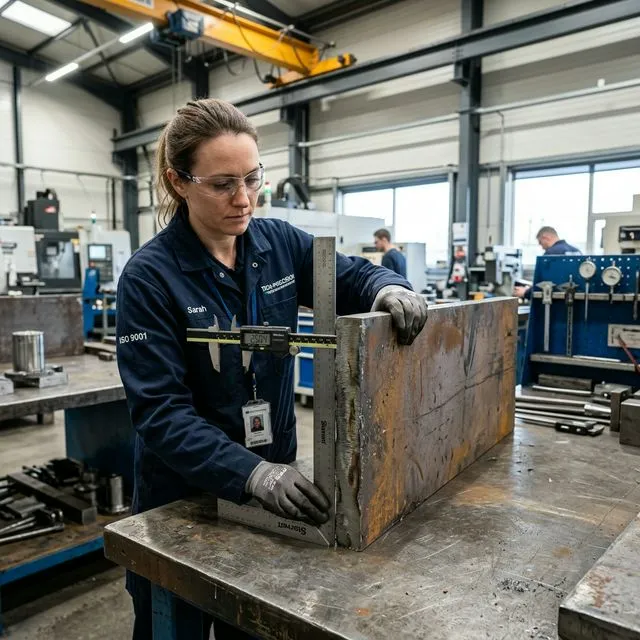
Perpendicularity measures how straight the cut edge is relative to the sheet surface. A perfectly perpendicular cut has u = 0. In practice, the beam diverges as it passes through material, creating a slight taper (wider at bottom for fiber, wider at top for CO₂ in some conditions).
Measurement Procedure
How to Improve Perpendicularity
3. Surface Roughness (Rz5)
Rz5 is the mean peak-to-valley height averaged over 5 consecutive sampling lengths on the cut surface. It quantifies the visible striations (drag lines) on the cut edge. Lower values indicate smoother surfaces. Learn more in our dedicated Edge Roughness Measurement Guide.
4. Practical Example: Specifying Quality Class
| Application | Material | Typical Spec | Drawing Note |
|---|---|---|---|
| Architectural panel | 3mm SS 304 | Range 1 | Cut quality ISO 9013 Range 1 |
| Machine frame | 12mm S355 | Range 2 | Cut quality ISO 9013 Range 2 |
| Structural bracket | 20mm S275 | Range 3 | Cut quality ISO 9013 Range 3 |
| Weld prep blank | 25mm S355 | Range 4 | Thermal cut, ISO 9013 Range 4 min |
Frequently Asked Questions
What is ISO 9013?
ISO 9013 is the international standard for classifying thermal cutting quality. It defines 4 ranges based on perpendicularity (u) and surface roughness (Rz5), providing objective criteria for specifying cut quality on engineering drawings.
Can fiber lasers achieve Range 1?
Yes, on thin-to-medium materials (carbon steel up to ~12mm, stainless up to ~6mm) with optimized parameters. Range 2 is the standard achievable quality for general fiber laser cutting across most materials and thicknesses.
How do I measure perpendicularity?
Use a precision square against the sheet surface and measure the gap with feeler gauges. Exclude the top and bottom 10% of the edge (burr zones). Record the maximum deviation. For production QC, a profile projector provides faster and more repeatable measurements.
Related Guides
Reference: ISO 9013:2017 — Thermal cutting — Classification of thermal cuts — Geometrical product specification and quality tolerances. This guide provides practical interpretation; always consult the full standard for contractual or certification purposes.