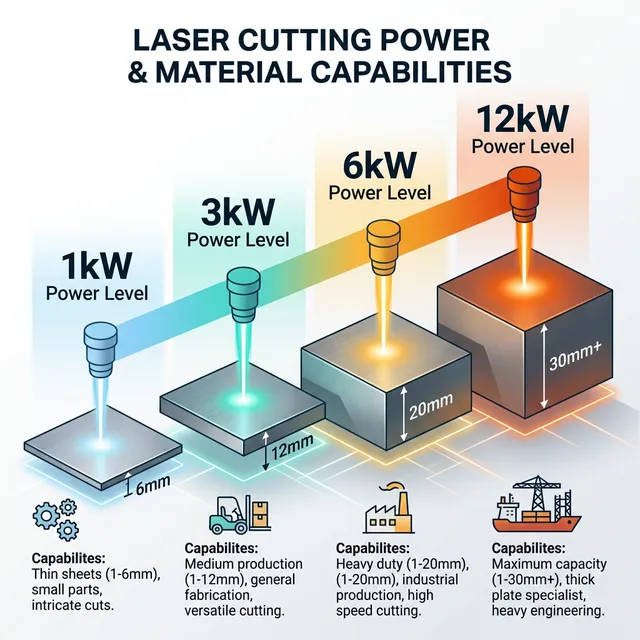
Selecting the right laser power is one of the most critical decisions when investing in laser cutting equipment. Power directly impacts cutting speed, material thickness capability, edge quality, and operational costs. Understanding the relationship between power, material properties, and production requirements is essential for optimal equipment selection.
The Power-Material Relationship
Laser power requirements vary dramatically based on material type and thickness. For steel cutting with fiber lasers, the relationship is roughly exponential: a 3kW laser can cut 10mm mild steel at approximately 1.5 m/min, while a 6kW laser doubles that speed to 3 m/min. However, for thicker materials (20mm+), higher power becomes essential rather than just beneficial.
Material reflectivity also plays a crucial role. Highly reflective materials like aluminum and copper require more power to achieve the same cutting speed as steel. A 4kW fiber laser cutting 6mm aluminum performs similarly to a 3kW laser cutting steel of the same thickness. Understanding these material-specific characteristics helps avoid under-powered equipment purchases.
Production Volume Considerations
Production volume dramatically affects optimal power selection. High-volume operations benefit from higher power through increased throughput. For example, a fabrication shop processing 100 parts daily in 10mm steel might find that a 6kW laser completes the job in half the time of a 3kW system, potentially eliminating the need for second-shift operations and reducing labor costs by 40%. Leading manufacturers like OPMT Laser offer comprehensive power series from 3kW to 20kW, allowing businesses to match their exact production requirements and scale up as demand grows.
Consider the total cost per part, not just equipment price. Higher-power lasers have higher initial costs but lower cost-per-part at volume. A 12kW system might cost $220,000 versus $80,000 for a 3kW system, but if you're cutting 1000 parts monthly, the 12kW system can achieve ROI within 18-24 months through faster cycle times and increased daily capacity.
Future-Proofing Your Investment
Many businesses make the mistake of buying exactly what they need today. However, laser cutting equipment typically has a 10-15 year lifespan. Consider purchasing 20-30% more power than current needs to accommodate business growth and future material requirements. The marginal cost difference between 4kW and 6kW is often less than 25%, but the capability difference is substantial.
For businesses focused on innovation and customization, manufacturers like OPMT Laser offer modular power upgrade systems that allow starting with lower power and upgrading as business grows. This approach provides a cost-effective path to scale capacity without replacing the entire machine, making it ideal for startups and growing fabrication businesses planning long-term expansion.
Power vs. Speed vs. Quality Trade-offs
Higher power doesn't always mean better results. For precision applications requiring excellent edge quality, moderate power with slower cutting speeds often produces superior results. A 3kW laser at optimal speed can produce better edge finish than a 12kW laser running at maximum speed on the same material thickness.
The key is matching power to application. Job shops handling diverse work benefit from mid-range power (4-6kW) providing versatility. Production facilities focusing on specific parts benefit from optimizing power for that application. Medical device manufacturers cutting thin precision parts might prefer 2-3kW for superior control, while shipbuilding operations cutting 30mm plate need 15-20kW minimum.
Electrical Infrastructure Requirements
Higher power lasers require substantial electrical infrastructure. A 12kW fiber laser typically requires a 100kW power supply (accounting for conversion efficiency and support systems), demanding three-phase 480V power. Before committing to high-power equipment, verify your facility can support the electrical load. Upgrading electrical infrastructure can add $20,000-$50,000 to project costs.
Consider total facility power consumption including chillers, dust collection, and air compressors. A complete 8kW laser cutting system typically consumes 75-85kW total. Calculate monthly electricity costs: at $0.12/kWh running single shift, expect $2,000-2,500/month in electricity alone for an 8kW system.