[LOADING GUIDES...]
Application advice
Need help applying this guide to a real purchase or process setup?
Send your material, thickness, machine power, budget, or supplier question. We can help translate the guide into practical next steps.
[LOADING GUIDES...]
Application advice
Send your material, thickness, machine power, budget, or supplier question. We can help translate the guide into practical next steps.

If you are trying to improve nesting, this page is the operating guide: what changes sheet utilization, what breaks automated nests, and how to calculate payback before you commit to new software or workflow changes. It is written to answer real search intent around nesting optimization, not just define the term.
Bottom Line: Improving nesting utilization from 75% to 85% on $50,000/month steel consumption saves about $70,588/year before labor and cycle-time gains. Use that number as a business-case baseline, not as a vendor promise.
Nesting optimization is the process of arranging cutting patterns on sheet material to maximize utilization while minimizing production time. Effective nesting balances multiple objectives: material yield, cutting efficiency, part quality, and remnant usability.
Place largest/highest-priority parts first, then fill gaps with smaller parts. This prevents "trapped space" where large parts won't fit after small parts consume sheet real estate.
Maintain 3-5mm from sheet edge to prevent edge warping from affecting cut quality. Thicker materials and high-power cutting require larger margins (5-8mm for 20mm+ steel).
Standard 1-3mm spacing prevents thermal interaction and enables common-line cutting. Reflective materials (aluminum) require 2-4mm due to heat dissipation concerns.
For parts requiring subsequent bending, align with rolling direction (marked on material). Incorrect orientation causes 20-30% strength reduction and cracking risk.
Locate pierces away from critical dimensions and at thickest material sections. Poor pierce placement causes 5-15% of quality rejects in precision work.
Simple grid layout for regular parts. Fast to program (5-10 minutes manual), predictable results, but leaves significant waste on irregular parts.
Parts rotated/mirrored for optimal fit, software calculates actual part geometry. Requires nesting software ($3,000-15,000) but recovers cost within 1-3 months.
Adjacent parts share cut path, eliminating inter-part kerf waste. Saves 8-12% material PLUS 15-25% cutting time. Requires parts with matching edges and compatible quality requirements.
Advanced algorithms (SigmaNEST, Lantek Expert) test thousands of arrangements, approaching theoretical maximum. Computation time 1-5 minutes vs 30 seconds for basic nesting, but justifies delay on high-value materials.
Use the ROI table as a shortlist filter. Professional nesting software typically recovers its cost in 1-6 months through material savings alone, not counting time savings and quality improvements. Selection criteria: material utilization capability, automation level, CAD/CAM integration, learning curve, and total cost of ownership.
| Software | Cost Range | Utilization | Best For | Payback Fit / Risk |
|---|---|---|---|---|
| SigmaNEST | $8,000-15,000 $300-700/mo typical SaaS | 90-95% | High-volume job shops with mixed part geometry and remnant tracking needs | Best when monthly material spend exceeds $40,000 Implementation risk: medium |
| Lantek Expert | $10,000-20,000 $350-800/mo typical SaaS | 85-92% | Enterprise fabrication teams that need MES, inventory, and scheduling integration | Best when nesting must connect with ERP/MES workflows Implementation risk: high |
| ProNest | $8,000-15,000 $250-650/mo typical SaaS | 88-94% | Laser, plasma, and oxyfuel shops needing robust quoting and process costing | Best for shops that quote many jobs from imported CAD files Implementation risk: medium |
| FastCAM | $3,000-6,000 $100-250/mo typical SaaS | 85-90% | Small and midsize fabricators moving away from manual CAD nesting | Best when budget is constrained but current utilization is below 75% Implementation risk: low |
| RDWorks / LightBurn | $60-150 $0-20/mo typical SaaS | 75-82% | Low-volume CO2/non-metal work with simple rectangular or repeated parts | Best for hobby, signage, and simple small-shop workflows Implementation risk: low |
Hidden Costs: Consider annual maintenance (15-20% of license), training (1-2 weeks at $1,000-3,000), and post-processor customization ($500-2,000). Total 3-year TCO is typically 140-160% of initial license cost. However, improving utilization from 75% to 80% on $50,000/month material spend saves about $37,500/year in material alone, giving a $10,000 package a short payback even before time savings.
Treat DXF cleanup as the quality gate before any nesting ROI trial. Poor CAD files can make good nesting software look ineffective by creating false boundaries, double cuts, and unreliable cycle-time estimates.
| Check | Why It Matters | Pass Criteria |
|---|---|---|
| Closed contours only | Open contours make algorithms misread part boundaries and can block common-line cutting. | Every external profile and internal cutout imports as a closed polyline. |
| No duplicate or overlapping entities | Duplicate lines cause double cuts, bad cycle-time estimates, and local overheating. | CAD cleanup finds zero overlapping line segments before nesting import. |
| Splines converted to polylines | Many CNC controllers and nesting engines approximate splines inconsistently. | Curves are exported as polylines with 0.05-0.10mm chord tolerance. |
| Kerf ownership is explicit | Kerf applied in both CAD and CAM creates undersized parts; missing kerf creates oversized parts. | Either CAD geometry or nesting software owns kerf compensation, not both. |
| Layer naming maps to operations | Mixed engraving, cut, pierce, and mark layers increase programming errors. | Cut, mark, etch, and construction geometry are separated into clear layers. |
For a deeper CAD cleanup workflow, use the dedicated DXF Nesting Best Practices page, then return here to evaluate utilization and ROI.

Two or more adjacent parts share a single cut path, eliminating inter-part kerf and spacing waste. Benefits: 8-12% material savings, 15-25% time reduction (fewer pierces and cuts), improved part nesting density.
ROI Example: Shop cutting 100 identical 300×300mm brackets/day. Common-line nesting reduces 200 brackets (mirrored pairs) to 100 cut operations, saving 4 hours/day cutting time (worth $80-150/day) plus 10-12% material.
Systematic tracking and reuse of off-cuts reduces scrap costs by 30-60%. Requires discipline but highly profitable on expensive materials (stainless, aluminum, high-strength alloys).
Implementation: Manual tracking (spreadsheet) for small shops, database-integrated tracking (Lantek, SigmaNEST modules) for high-volume operations. Barcode labels ($200 printer, $0.05/label) streamline tracking.
By 2026, the industry has shifted toward cloud-computed genetic algorithms (like those powering recent software updates). Instead of locking up a local workstation for hours, complex nests are calculated on massive AWS/Azure server clusters.
Future Proofing: Modern APIs allow laser cutting businesses to offer instant 'upload-to-quote' portals, where the cloud engine invisibly nests the DXF and returns an exact material cost in real-time.
Nesting optimization delivers ROI through three channels: material savings (largest), time savings (secondary), and quality improvements (often overlooked but significant). Below is a structured methodology to quantify benefits and justify software/training investments.
Current State:
Investment: FastCAM software $5,000 + $300/year maintenance + $2,000 training = $7,300 first year
Projected Improvement:
Annual Savings:
Payback Period: 0.5 months on total annual savings, or 1.2 months on material savings alone
Conservative estimate assumes 50% of theoretical time savings realized due to production scheduling constraints. Material savings are immediate and measurable.
Current State:
Investment: SigmaNEST $12,000 + $2,400/year maintenance + $4,000 training = $18,400 first year
Projected Improvement:
Annual Savings:
Payback Period: 0.6 months on total annual savings, or 1.0 month on material savings alone
High-volume operations see fastest ROI due to scale. At 82% current utilization, each target utilization point near 90% is worth roughly $26,000-$32,000/year on this material spend. Advanced software can be justified even if improvement is only 3-4 points.
Implementation Tip: Start with a 2-week trial of nesting software (most vendors offer evaluation licenses). Run 10-20 typical jobs through trial software, measure actual utilization improvement, and extrapolate annual savings. This data-driven approach removes guesswork and provides concrete ROI for management approval. Document before/after results with screenshots for compelling business case.
Nesting software ROI varies dramatically by industry due to differences in material costs, part complexity, and production volume. Here are three representative scenarios with real payback calculations.
Tier 1 enterprise software like SigmaNEST or Lantek Expert costs between $10,000 and $20,000 for a perpetual license, or $200-$500/month for cloud subscriptions. Mid-tier options like FastCAM run $3,000-$6,000. Basic 2D profile software is often included free with the machine.
For a shop spending $50,000/month on sheet metal, improving nesting utilization from 75% to 85% yields about $5,882/month in material savings before labor and cycle-time gains. A $15,000 software and training package would pay back in roughly 2.6 months if the utilization improvement is achieved.
Common-line cutting is a nesting technique where two adjacent parts are positioned to share the exact same cut path. This eliminates the skeleton web between them, saving 8-12% in material yield and reducing laser cutting cycle time by 15-25% since fewer pierces are required.
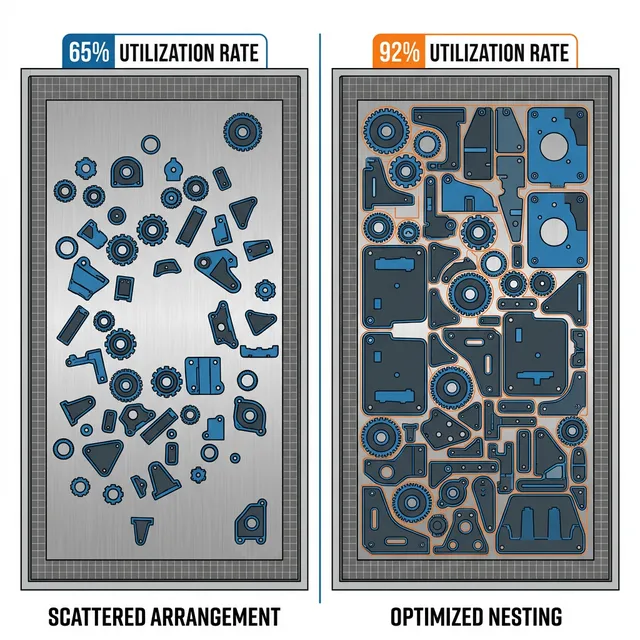
True-Shape nesting is the 2026 industry standard. Rectangular array nesting treats all parts as bounding boxes, wasting massive amounts of sheet space for irregular parts. True-Shape algorithms interlock complex geometries, boosting sheet utilization from a typical 75% up to 90-95%.
Tip: Optimize CAD drawings before nesting (closed contours, shared edges, simplified small features) to significantly improve utilization and processing efficiency.